Peter's electronic projects Peter's electronic projects
While the physical paperback remains standard, digital versions and specific study guides are accessible through various educational platforms. Physics Aki Ola | PDF | Litre - Scribd
Aki-Ola Physics series is a premier educational resource specifically designed for the
For decades, Aki-Ola publications have been the go-to study aids for junior and senior high school students in Ghana and neighboring countries. The Physics edition is specifically designed to bridge the gap between complex theoretical physics concepts and the structured requirements of the West African Examinations Council (WAEC) syllabus.
: Many websites promising "free PDF downloads" embed malicious software, adware, or phishing links into their download buttons.
Before the era of PDFs and tablets, the physical Aki Ola book was a permanent fixture in school bags. Its popularity isn't just marketing hype; it is built on a specific teaching methodology that works for the average student.
Work through the questions at the end of each chapter.
: Interference, diffraction, and polarization of light waves. 4. Electricity and Magnetism
Magnetic fields, electromagnetic induction, and transformers. 5. Atomic and Nuclear Physics Structure of the Atom: Atomic models and radioactivity. Electronics: Diodes, transistors, and logic gates. Why Choose Aki Ola Physics PDF?
While searching for an "Aki Ola Physics PDF" online, students often encounter various third-party download sites. It is important to keep the following in mind:
Cover the solution to a worked example with your hand. Attempt to solve it. Then reveal the book's solution. If you got it wrong, trace exactly where your logic failed. This is called "Example-Led Learning," and the Aki Ola PDF is perfect for it.
 Try it now, before building! Click on the transmitter buttons with the
green
labels
on the left and see how the receiver outputs (K1-K8) change. Change
the number of transmitter or receiver channels. Switch the receiver
output type between latched and momentary.
Try it now, before building! Click on the transmitter buttons with the
green
labels
on the left and see how the receiver outputs (K1-K8) change. Change
the number of transmitter or receiver channels. Switch the receiver
output type between latched and momentary.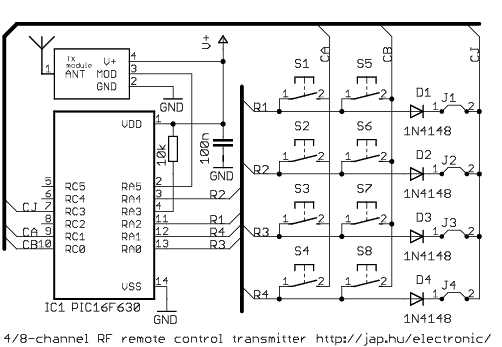
| part | description |
| C1 |
100nF ceramic capacitor |
| R1 |
10k resistor (1/8W) |
| D1-D4 | 1N4148 diode (optional) |
| S1-S8 |
tact switch, DTSM 61N or similar |
| IC1 | PIC16F630 or PIC16F676 microcontroller, pre-programmed |
| TXMOD |
radio
transmitter module, see text (hardware) |
| B1 |
battery between 2-5.5VDC (check TXMOD specs for valid voltage range) |
| part | description |
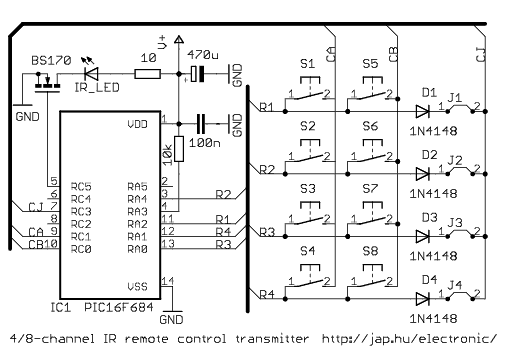
| C1 |
100nF ceramic capacitor |
| C2 |
470 uF 6.3V, electrolytic
capacitor |
| R1 |
10k resistor (1/8W) |
| R2 |
10 ohm resistor (1/4W) |
| D1-D4 | 1N4148 diode (optional) |
| D5 |
IR transmitter LED |
| Q1 |
BSS138 or similar N-MOSFET |
| S1-S8 |
tact switch, DTSM 61N or similar |
| IC1 | PIC16F684 microcontroller, pre-programmed |
| B1 |
battery between 2-5.5VDC (CR2032, 3.6V LiIon battery or 3xAA
batteries) |
| please
observe the corresponding address configuration! |
|
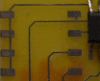 transmitter: no diodes connected |
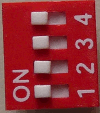 receiver: switches all ON |
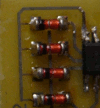 transmitter: all diodes connected |
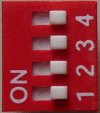 receiver: switches all OFF |
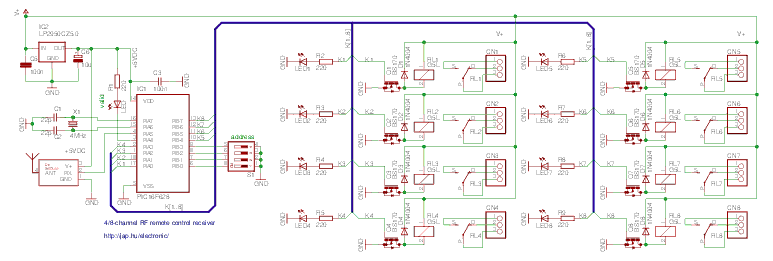
parts list
| part | description |
| C1, C2 | 22pF ceramic capacitor |
| C3, C5 | 100nF ceramic capacitor |
| C6 | 10uF 6.3V electrolytic capacitor |
| CN1-CN8 | PCB terminal block, 3-way (DG301) |
| D1-D8 | 1N4004 diode |
| IC1 | PIC16F627 or PIC16F628 or PIC16F627A or PIC16F628A microcontroller, pre-programmed |
| IC2 | LP2950CZ5.0 voltage regulator |
| LED | 3mm LED (green) |
| LED1-LED8 | 3mm LED (red) |
| Q1-Q8 | BS170 N-channel mosfet transistor |
| R1-R9 | 220R resistor (1/8W) |
| RL1-RL8 | G5LE relay, see text for coil voltage selection |
| S1 | piano DIP switch, 4-way |
| X1 | 4MHz HC49 crystal |
| RXMOD | 3-pin radio receiver module, see text (hardware) |
| please
observe the corresponding address configuration! |
|
| transmitter: no diodes connected |
receiver: switches all ON |
| transmitter: all diodes connected |
receiver: switches all OFF |
While the physical paperback remains standard, digital versions and specific study guides are accessible through various educational platforms. Physics Aki Ola | PDF | Litre - Scribd
Aki-Ola Physics series is a premier educational resource specifically designed for the
For decades, Aki-Ola publications have been the go-to study aids for junior and senior high school students in Ghana and neighboring countries. The Physics edition is specifically designed to bridge the gap between complex theoretical physics concepts and the structured requirements of the West African Examinations Council (WAEC) syllabus.
: Many websites promising "free PDF downloads" embed malicious software, adware, or phishing links into their download buttons.
Before the era of PDFs and tablets, the physical Aki Ola book was a permanent fixture in school bags. Its popularity isn't just marketing hype; it is built on a specific teaching methodology that works for the average student.
Work through the questions at the end of each chapter.
: Interference, diffraction, and polarization of light waves. 4. Electricity and Magnetism
Magnetic fields, electromagnetic induction, and transformers. 5. Atomic and Nuclear Physics Structure of the Atom: Atomic models and radioactivity. Electronics: Diodes, transistors, and logic gates. Why Choose Aki Ola Physics PDF?
While searching for an "Aki Ola Physics PDF" online, students often encounter various third-party download sites. It is important to keep the following in mind:
Cover the solution to a worked example with your hand. Attempt to solve it. Then reveal the book's solution. If you got it wrong, trace exactly where your logic failed. This is called "Example-Led Learning," and the Aki Ola PDF is perfect for it.
LATCH_MASK EQU B'00001111' sets channels 8-5 to momentary
and
channels 4-1 to latched (toggle) mode. Then use the compiler (MPLAB or
gputils) to
assemble the code.clrf
0x91 ;
ANSEL