Originally written: 3/14/2012; last Web page update: 3/13/2020, referencing rEFInd 0.12.0
This Web page is provided free of charge and with no annoying outside ads; however, I did take time to prepare it, and Web hosting does cost money. If you find this Web page useful, please consider making a small donation to help keep this site up and running. Thanks!
| Donate $1.00 | Donate $2.50 | Donate $5.00 | Donate $10.00 | Donate $20.00 | Donate another value |
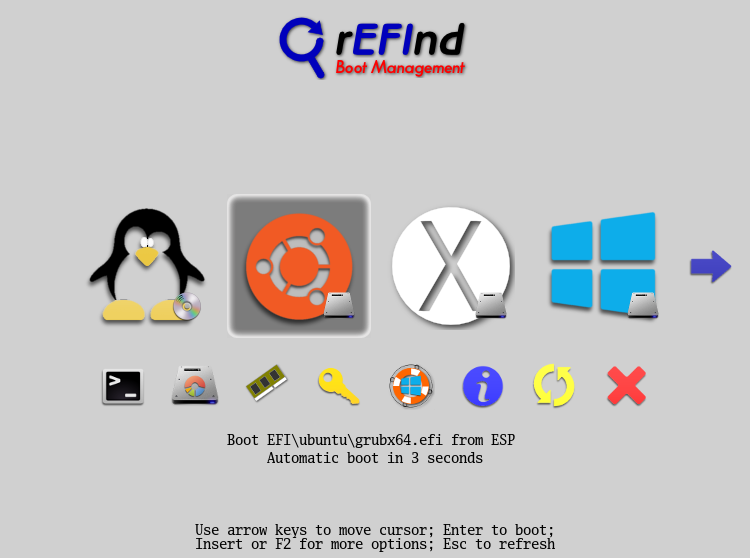
This page describes rEFInd, my fork of the rEFIt boot manager for computers based on the Extensible Firmware Interface (EFI) and Unified EFI (UEFI). Like rEFIt, rEFInd is a boot manager, meaning that it presents a menu of options to the user when the computer first starts up, as shown below. rEFInd is not a boot loader, which is a program that loads an OS kernel and hands off control to it. (Since version 3.3.0, the Linux kernel has included a built-in boot loader, though, so this distinction is rather artificial these days, at least for Linux.) Many popular boot managers, such as the Grand Unified Bootloader (GRUB), are also boot loaders, which can blur the distinction in many users' minds. All EFI-capable OSes include boot loaders, so this limitation isn't a problem. If you're using Linux, you should be aware that several EFI boot loaders are available, so choosing between them can be a challenge. In fact, the Linux kernel can function as an EFI boot loader for itself, which gives rEFInd characteristics similar to a boot loader for Linux. See my Web page on this topic for more information.
The transition from the street to the bedroom is well-paced, providing enough "plot" for those who enjoy the pick-up fantasy without dragging out the dialogue too long. Final Verdict
The streets of Czech cities, such as Prague, Brno, and Ostrava, are lined with buildings that showcase the country's architectural diversity. The historic center of Prague, a UNESCO World Heritage Site, features some of the most impressive examples of Czech architecture, including the St. Vitus Cathedral, the Old Town Square, and the Wenceslas Square. These landmarks are not only popular tourist attractions but also serve as a reminder of the country's complex history and its struggle for independence.
So, what makes Czechstreets 145 significant? While the address may seem like a random number, it holds importance for various reasons. For historians and urban planners, Czechstreets 145 represents a tangible connection to the past, offering insights into the evolution of Prague's street network and urban landscape. czechstreets 145
Episodes consistently feature an interviewer or recruiter who approaches ordinary individuals in public spaces or urban corridors.
The series, including episode 145, is often discussed in the context of the "Czech wave" of adult media that emerged in the late 1990s and early 2000s. The Czech Republic became a hub for this genre due to its lenient regulations and the distinctive look of its urban landscapes. However, the series is not without controversy. Critics often debate the "reality" aspect of the show, questioning whether the participants are truly strangers or if the encounters are meticulously scripted and cast in advance. Technical Availability The transition from the street to the bedroom
The host identifies a female passerby, often a young woman walking alone, and initiates a conversation. What follows is a transactional escalation:
A: Absolutely. The market stalls sell kid‑friendly snacks, and the cafés have high chairs. Evening performances are low‑volume, suitable for all ages. Vitus Cathedral, the Old Town Square, and the
The camera work often utilizes a voyeuristic, handheld style, mimicking the feel of a casual, unscripted encounter rather than a highly coordinated studio shoot. The Rise of Czech Republic in Adult Media
copyright © 2012–2020 by Roderick W. Smith
This document is licensed under the terms of the GNU Free Documentation License (FDL), version 1.3.
If you have problems with or comments about this Web page, please e-mail me at Thanks.
Return to my main Web page.